Every STL is gated
Manifold check, flat-bottom check, bed-fit check on every render. A part that fails does not ship, and a script's claim is never taken as evidence.
Commodity compute, an open flight stack and a desktop printer, integrated tightly enough to behave like one instrument. Every layer is documented, versioned and verified against source.
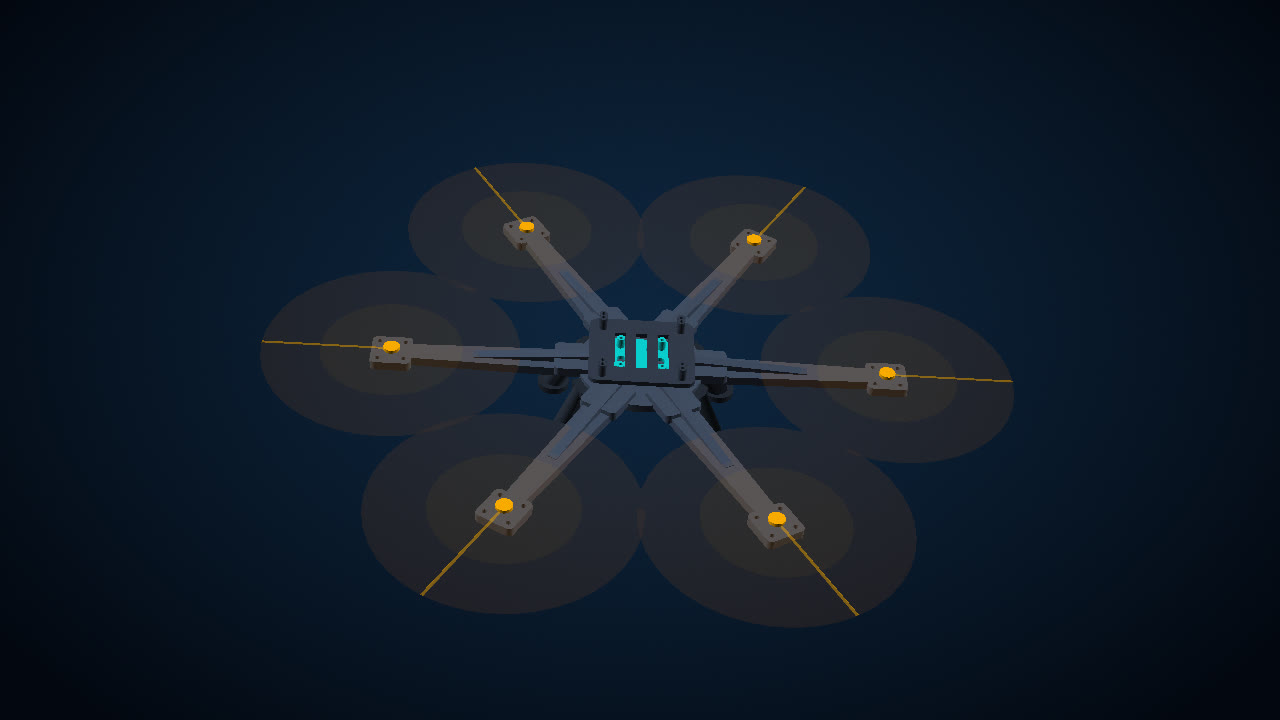
Parametric OpenSCAD, one file per printable part. Manifold, flat-bottom, inside a 256 mm Bambu A1 bed; joinery where a part would not fit. Locked motor pad: 16 × 16 mm M3, 8 mm bore.
2300 KV motors on 5″ props, 4S 14.8 V packs with per-cell monitoring, 3S bench pack for first hover. Voltage/current telemetry into the flight controller and the fleet monitor.
Pixhawk 6C running ArduPilot Copter 4.6.3. Parameter files gate-verified against the tagged source: ranges, bitmasks, battery thresholds, E-stop and failsafe behaviour.
Raspberry Pi 5 with a Hailo-8L accelerator (13 TOPS). Motion gate → classifier → detection events. MAVLink Guided-mode commands from the companion, with the vehicle's own system id so failsafes stay intact.
ESP32 nodes for ranging, PIR and pack telemetry on a documented wire protocol. 3.3 V logic throughout; level-shifted where a 5 V part is unavoidable.
Every airframe posts telemetry and detections over an authenticated link to the operator console: battery, position, thermals, inference rate, health probes and a full audit trail.
Every link is a real interface in the Test #1 build. Detection events travel to the console; video never leaves the aircraft.
Inference runs on the aircraft at roughly 28 frames per second. No uplink is required for the drone to perceive: no cloud dependency, no video leaving the airframe, and a telemetry stream small enough for a long-range radio.
Manifold check, flat-bottom check, bed-fit check on every render. A part that fails does not ship, and a script's claim is never taken as evidence.
Flight parameters are validated against the tagged ArduPilot source tree, not the wiki. Three invalid lines were caught this way before the first hover.
A nine-stage bench sequence on a small 3S pack, including E-stop, radio and GCS failsafe tests, before any airframe leaves the ground.